
What do I do when my Hindu family tries to arrange my marriage faster to "correct" me?
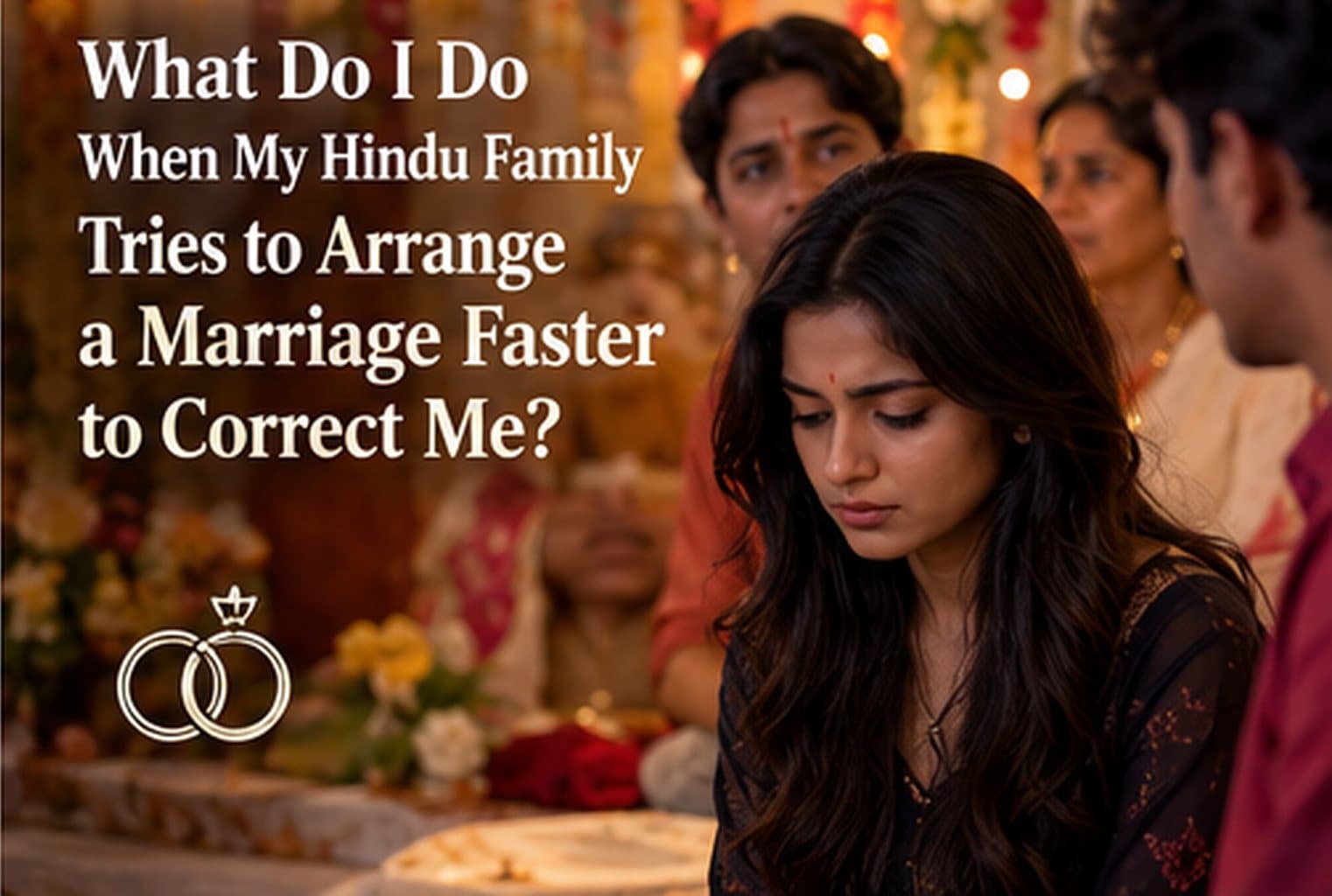
A month after your parents found out about your faith, the biodatas start showing up on WhatsApp. Then your mom says a family is coming over Sunday "just to meet." By Monday, your dad is talking about a date in January. Nobody says it out loud, but you know what this is: a good Hindu marriage is supposed to bring you back.
Here's the short answer: you are allowed to say no, or not yet. Your family can introduce you to people, but they cannot choose your spouse for you. You can honor your parents and still refuse to marry someone who doesn't share your faith. And if the pressure turns into threats or force, that is a forced marriage, it's a serious harm, and there is real help available.
Arranged is not the same as forced
Arranged marriage isn't wrong in itself. Many Christians in India and around the world meet their spouse through family introductions. The question is who makes the final choice.
Arranged marriage: family members help with matchmaking, but you keep the final say on whether, when and whom you marry (Tahirih Justice Center).
Forced marriage: one or both people do not, or cannot, consent, and force, fraud or coercion is used (Tahirih Justice Center). The UK government describes it as a marriage where consent is missing "and pressure or abuse is used" (GOV.UK). It can happen to men and women, in any culture or religion.
Why families rush. To your parents, marriage may feel like the fix. A Hindu spouse, a Hindu home and the duties of married life might, they hope, pull you back into the family faith. They may also want to settle things before relatives find out. Understanding this can help you respond with compassion, even while you hold your ground.
What the Bible says
Marry someone who shares your faith. "Do not be unequally yoked with unbelievers. For what partnership has righteousness with lawlessness? Or what fellowship has light with darkness?" (2 Corinthians 6:14). Marriage joins two lives at the deepest level. Building a home where one of you worships Jesus and the other doesn't is a weight Scripture asks you not to take on.
You're free to marry, "only in the Lord." Paul says a widow "is free to be married to whom she wishes, only in the Lord" (1 Corinthians 7:39). The principle is the same for you: freedom to choose, inside faithfulness to Christ.
Keep honoring your parents. "Honor your father and mother" (Ephesians 6:2). Honor means respect, gratitude and care. It doesn't mean letting them choose a spouse who would pull you away from God. You can say no to the match and yes to your parents.
God sees the bigger picture. You don't have to panic or rush into a different marriage to escape this one. Waiting on God's timing is not failure.
Pressure or force? How to tell
| Still an arrangement | Crossing into forced marriage |
|---|---|
| They share biodatas and set up meetings | They set a wedding date without your agreement |
| They push, plead and get upset | They threaten to hurt you, disown you violently, or harm someone you love |
| You can say no to a match and they move on | Saying no is not accepted as an answer |
| You keep your phone, money and ID | Your phone, passport or ID is taken or hidden |
| Travel is your choice | A sudden "family trip" abroad is planned, and you suspect a wedding |
| You can see friends and go to work or school | You're kept home, watched or cut off from people |
If anything in the right column is happening, skip ahead to the safety section.
What to say and do
1. Buy time. You don't have to win the argument today. Slowing things down is often the wisest first step.
- "I'm not ready to get married yet. I want to finish my studies/settle in my job first."
- "Marriage is the biggest decision of my life. I'm not going to rush it."
- "I'll meet them if you'd like, but please don't make any promises to their family."
2. Be honest about your conviction. When you're ready and it's safe:
- "I love you, and I want a marriage you can be happy about. But I can only marry someone who shares my faith in Jesus."
- "I know you think marriage will change my mind. It won't, and it wouldn't be fair to the other person to pretend."
That second line matters. Marrying someone while hiding your faith, hoping it works out, would hurt them too.
3. Find an ally. A respected uncle, aunt, older cousin or family friend can sometimes speak to your parents in ways you can't. A pastor or Christian mentor can help you plan, pray and think through options.
4. Stay respectful, even when you refuse. Thank them for caring about your future. Don't mock their beliefs or the families they introduce. A calm, kind "no" is much harder to dismiss than an angry one.
If you're a hidden believer, and staying safe
If your family doesn't know about your faith, a rushed proposal can feel like a trap. You can still delay without announcing everything: focus on timing ("not yet") and on what you want in a spouse ("someone kind, honest, who shares my values"). Talk with a trusted believer before you decide how much to share. Jesus said to be "wise as serpents and innocent as doves" (Matthew 10:16).
Make a quiet safety plan, especially if you see warning signs:
- Keep your passport, ID and some money where you can reach them, or with someone you trust. If you travel, share your passport details, flight information and destination address with a trusted friend (Tahirih Justice Center).
- Avoid traveling abroad if you think a wedding might be planned there (Tahirih Justice Center).
- Protect your communication. Your messages and calls may be monitored. Use an email account no one knows about and a device only you control (Tahirih Justice Center).
- Agree on a code word with a friend that means "I need help."
Know your rights. Forced marriage is a crime in England, Wales and Scotland, with sentences up to 7 years (GOV.UK). Basic human rights law says marriage must be entered "only with the free and full consent of the intending spouses" (Tahirih Justice Center).
Get help:
- In immediate danger: call 911 (US) or 112 (India) (Ministry of Home Affairs).
- US: Tahirih Justice Center's Forced Marriage Initiative. Call 571-282-6161 (Mon to Fri, 9 a.m. to 5:30 p.m. Eastern) or email FMI@tahirih.org (Tahirih).
- US citizens abroad: contact the State Department's Office of Overseas Citizens Services at 1-202-501-4444, or go to the nearest US Embassy or Consulate (Tahirih).
- UK, or British nationals abroad (including dual nationals): the Forced Marriage Unit at +44 (0) 20 7008 0151 or fmu@fcdo.gov.uk (GOV.UK).
Reaching out for help is not betraying your family. It's protecting the life God gave you, and it can protect your family from doing something they would deeply regret.
Your future belongs to God
Your parents want you settled, safe and happy. So does God. The difference is that he won't force it, and neither should anyone else. You can wait, pray, and say a kind but firm no, trusting that the God who brought you to Jesus can also lead you to the right person in the right time.
Reflect:
- Is what you're facing pressure, or is it starting to look like force?
- Who is one person in your family or church who could be your ally?
- What would it look like to say "not yet" kindly this week?
Sources
- Tahirih Justice Center: Forced Marriage Initiative, Get Help
- Tahirih Justice Center: 2023 Forced Marriage Fact Sheet
- GOV.UK: Forced marriage guidance
- Ministry of Home Affairs, India: Emergency Response Support System (112)
Scripture quotations are from the ESV® Bible (The Holy Bible, English Standard Version®), © 2001 by Crossway, a publishing ministry of Good News Publishers. Used by permission. All rights reserved.