
Can I celebrate Diwali as a follower of Jesus?
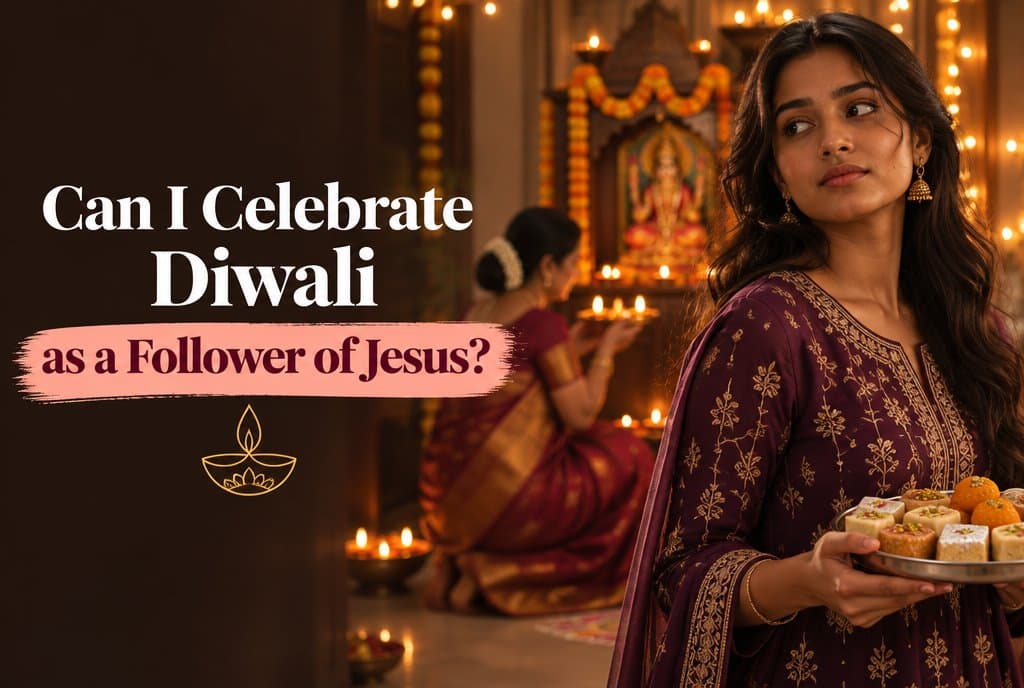
The string lights are up. The kitchen smells like ghee and cardamom. Your mom is wiping down the little shrine and asking what time you'll be home for the Lakshmi puja. Your cousins are already posting fireworks videos. It's Diwali, the biggest night of the year in your family. And you love Jesus.
So can you celebrate? Here's the short answer: you can share in a lot of Diwali with a clear conscience. The family, the food, the lights, the new clothes. But Diwali also has a center, and that center is the worship of Lakshmi and other gods. The key is joining the celebration while keeping your worship for Jesus alone.
Where Diwali comes from
Diwali is a religious festival at its core, but it has also become India's biggest family and cultural holiday. Its name comes from the Sanskrit dipavali, meaning "row of lights," and it celebrates light winning over darkness (Britannica).
Different regions tell different stories behind it (Britannica):
- Rama's return. In North India, Diwali celebrates Rama coming home to Ayodhya with Sita and Lakshmana after defeating the demon king Ravana.
- Lakshmi. Lamps are lit to welcome Lakshmi, the goddess of wealth. Some see the night as her wedding to Vishnu, others as her birthday.
- Krishna. In South India, it marks Krishna's defeat of the demon Narakasura.
- Kali. In Bengal, the goddess Kali is worshipped.
- Jains and Sikhs. Jains remember Mahavira's enlightenment. Sikhs celebrate Guru Hargobind's return to Amritsar from captivity.
The five days. Diwali usually runs five days: Dhanteras (cleaning the house and buying gold), Naraka Chaturdashi, Lakshmi Puja (the main night), Govardhan Puja (a new year for many merchants, who open new account books), and Bhai Dooj (honoring brothers and sisters) (Britannica).
The customs. Families light diyas (clay oil lamps), draw rangoli designs at the door, wear new clothes, visit relatives, swap gifts and sweets, set off fireworks and play cards for good luck (Britannica).
So Diwali isn't one thing. It's a worship night, a family reunion, a new year and a massive party all at once. That's exactly why followers of Jesus need to separate the parts.
What the Bible says
The Bible doesn't mention Diwali, but it speaks clearly to the two things Diwali mixes together: worship and celebration.
Worship belongs to God alone. "You shall have no other gods before me" (Exodus 20:3). Paul tells believers living in a city full of idol festivals, "You cannot drink the cup of the Lord and the cup of demons" (1 Corinthians 10:21). Lakshmi puja is a prayer for a goddess's blessing. That's the part to step out of.
Celebration and creation are good. "The earth is the Lord's, and the fullness thereof" (1 Corinthians 10:26). Lamps, sweets, new clothes and family meals aren't owned by any god. God himself filled Israel's calendar with feasts, lights and joyful gatherings.
Conscience and love decide the gray areas. "Whatever does not proceed from faith is sin" (Romans 14:23). And if your freedom would lead a newer believer to think worshipping other gods is fine, love may hold you back (1 Corinthians 8:9).
You already know the true Light. Diwali celebrates light winning over darkness. Jesus said, "I am the light of the world. Whoever follows me will not walk in darkness, but will have the light of life" (John 8:12). He also told his followers, "Let your light shine before others, so that they may see your good works and give glory to your Father who is in heaven" (Matthew 5:16). Diwali can be one of the most natural nights of the year to quietly point to him.
Which parts are okay and which aren't
The test for any moment of the night: is this directed at a god, or at the people I love?
| Part of Diwali | What it is | Our take |
|---|---|---|
| Lakshmi puja, Ganesh puja, Kali puja | Worship: prayers and offerings for a deity's blessing | Step out. Help in the kitchen or wait in the next room. |
| Aarti, bowing to the murti, receiving tilak | Worship and blessing | Politely decline. |
| Prasadam from the puja | Food given as the deity's blessing | Gently decline (1 Cor 10:28). |
| Lighting a diya placed before an idol or for Lakshmi to enter | An offering or invitation to the goddess | Skip it. |
| Lighting lamps or string lights to decorate the house | Decoration and celebration | A matter of conscience. Many Christians are free here. |
| Rangoli | A design at the doorway meant to welcome Lakshmi into the home | Politely decline. Its purpose is to invite the goddess in. Offer to help with cooking or cleaning instead. |
| Sweets, dinner, mithai boxes from friends | Food and hospitality | Enjoy. |
| New clothes, visiting relatives, gifts | Family and celebration | Yes. |
| Fireworks and sparklers | Fun and spectacle | Fine for most believers. They're for fun, not an offering. Skip any that are lit as part of the puja itself. |
| Card games for "good luck" | Gambling tied to luck for the new year | Skip the betting. Playing cards for fun is fine. |
| Bhai Dooj | Honoring siblings | Yes, if the ritual parts stay out. Love your siblings well. |
How to actually handle Diwali
Plan the puja moment ahead of time, then throw yourself into everything else.
- Ask when the puja is. Then you know when to be busy.
- Have a job. Fry the puris, set the table, watch the little cousins, take family photos. Serving is a loving way to step aside.
- Show up big for the rest. Wear the new kurta, hug every auntie, light the sparklers, eat the kaju katli. Let your family see that following Jesus made you more present, not less.
- Pray while you celebrate. Thank God for your family as the lamps glow. Ask him to bring them into his light.
- Point to the true Light. Diwali is a natural opening. You can say Jesus is the light you celebrate, without a sermon.
Simple things you can say:
- "I'll skip the puja part, but I'm here for everything else. What can I help with?"
- "I love being home for Diwali. I just pray to Jesus, so I'll sit out the puja."
- "For me, Diwali reminds me that Jesus is the light of the world."
- "Happy Diwali! I'm so glad we're all together."
If you're a hidden believer, you don't need to announce anything. Jesus said to be "wise as serpents and innocent as doves" (Matthew 10:16). Quiet absences during the puja, like being in the kitchen or running a family errand, are often enough. Don't lie to get out of it, but you don't owe everyone an explanation. If stepping out of the puja would put you at real risk, talk to a trusted believer or mentor before the day and make a plan together.
If you've joined a puja before, you're not disqualified. God knows the pressure you were under. Bring it to him (1 John 1:9) and decide ahead of time what you'll do this year.
Celebrate with them, worship him
If you're honest, the hardest part of Diwali probably isn't the puja. It's your parents' faces. You don't want to hurt them. You want them to be proud of you. Wanting your family's approval is normal and good. But most of the time, following Jesus will mean choosing him over the pujas, rituals and traditions at the heart of Diwali, even when it costs you some of that approval.
Paul felt this pull too: "Am I now seeking the approval of man, or of God?" (Galatians 1:10). You already have your Father's full approval in Christ, and nothing you skip this Diwali can take it away. That frees you to love your parents without needing them to understand you yet.
And you don't have to miss the whole night. You can still enjoy the family, the food, the new clothes and the joy of being together with a clear conscience. Keep your worship for God alone, and let your love for your family show in everything else.
This Diwali, every lamp in your home can remind you of the One who said he is the light of the world. And your love for your family might be the light they notice most.
Reflect:
- Which part of Diwali will be hardest for you this year, and what's your plan for it?
- What's one way you can serve your family during the celebration?
- How could you share what Jesus as "the light of the world" means to you?
Sources
Scripture quotations are from the ESV® Bible (The Holy Bible, English Standard Version®), © 2001 by Crossway, a publishing ministry of Good News Publishers. Used by permission. All rights reserved.