
Can a Christian go to garba or dandiya night?
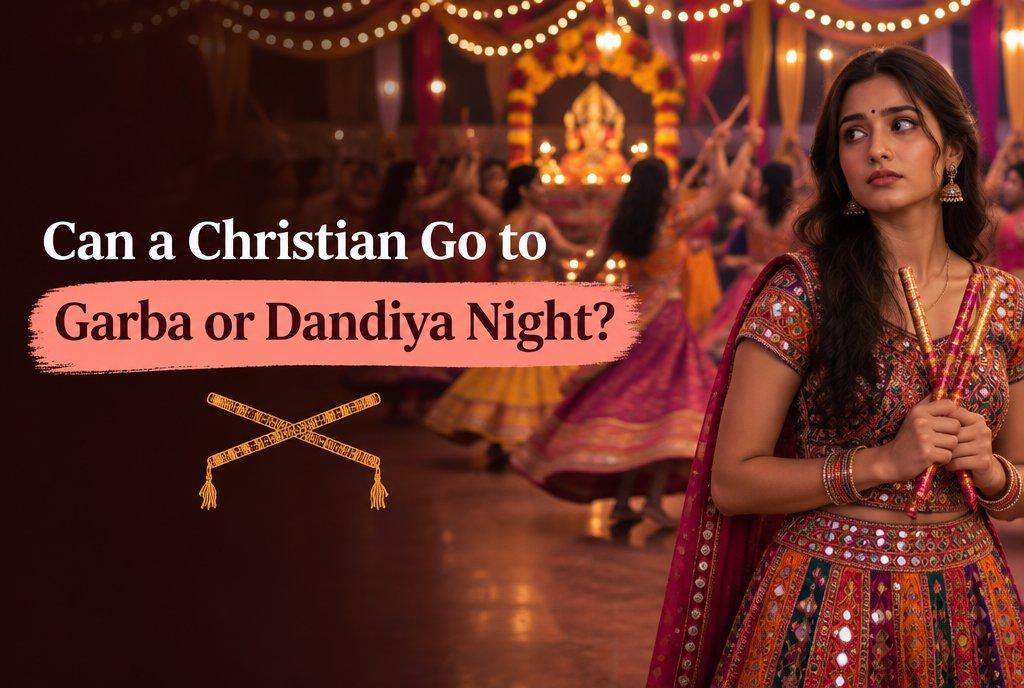
Navratri is here. Your cousins are planning outfits, your college's Indian student group is hosting a garba night, and your mom already bought you a chaniya choli. Everyone you love will be there. And you're wondering: can I go as a follower of Jesus?
Here's the short answer: going isn't automatically wrong, but not every part of the night is neutral. Garba began as worship of a goddess, and some parts of the evening still are. Other parts are just music, dancing and family. The key is knowing which is which, so you can show up with love and a clear conscience.
Where garba and dandiya come from
Both dances were born as worship of the goddess during Navratri. Today they are also huge social and cultural events, from village squares in Gujarat to college gyms in the US.
Navratri. The name means "nine nights." The festival honors the goddess Durga and her nine forms, with dancing on each of the nine nights (Homegrown). It celebrates Shakti, the divine feminine energy (UNESCO via NVLI).
Garba. The word comes from the Sanskrit garbha, meaning womb. Dancers circle a clay lamp called the garbha deep, which represents the body where the goddess's divine energy lives, or an image of the goddess Amba (UNESCO via NVLI). Today an image of Durga often sits at the center of the circle. The circle itself pictures the Hindu view of cyclical time, with the goddess as the unchanging center (Homegrown).
Dandiya. Dandiya Raas, the stick dance, is described as a socio-religious folk dance from Gujarat (Wikipedia). One tradition says it was first performed in honor of Durga and acts out her battle against the demon Mahishasura. Another links it to Krishna and Radha's raas leela, which is where the name comes from (Utsavpedia).
Aarti. Many events include an aarti, a ritual of waving lit lamps before the goddess while singing to her. Garba is often danced before the aarti and dandiya after it (Utsavpedia).
The social side. Garba has always been communal, bringing people of different classes, castes and even religions together, and UNESCO recognizes it as cultural heritage (UNESCO via NVLI). In the US, college Garba-Raas grew into a competitive circuit in the 2000s, judged on choreography like a sport (Wikipedia).
So a "garba night" can range from a temple service with dancing to a ticketed party with a DJ. Which one you're invited to matters a lot.
What the Bible says
Scripture draws one firm line and leaves a lot of room on either side of it. The firm line: we worship God alone. "You shall have no other gods before me" (Exodus 20:3). Paul puts it plainly for Christians living among idol festivals: "You cannot drink the cup of the Lord and the cup of demons" (1 Corinthians 10:21).
But Paul also says an idol is nothing in itself (1 Corinthians 8:4). Music, food, clothes and dancing are not owned by any god. "The earth is the Lord's, and everything in it" (1 Corinthians 10:26). Dancing in a circle with your cousins isn't worship of Durga just because it happens in October.
Three more principles help here:
- Jesus went to the party. He ate with people far from God and was criticized for it (Luke 7:34). Being present with your family and friends can be an act of love.
- Conscience matters. "Whatever does not proceed from faith is sin" (Romans 14:23). If you'd feel guilty at the event, don't go, even if another believer can.
- Love watches out for others. If your presence would lead a newer believer to think goddess worship is fine, it may be better to hold back (1 Corinthians 8:9).
So the question isn't really "garba, yes or no?" It's "which moments tonight are worship, and how do I step out of those?"
Which parts are okay and which aren't
Step out of anything directed at the goddess. Everything else is a matter of conscience and wisdom.
| Part of the night | What it is | Our take |
|---|---|---|
| Aarti to Durga or Amba | Worship: waving lamps and singing to the goddess | Skip it. Step back or stay at the edge of the room. |
| Bowing, touching the feet of the idol, offering flowers or money | Worship and devotion | Skip it. |
| Receiving tilak or kumkum from the priest | Receiving the goddess's blessing | Politely decline. |
| Dancing garba directly around a goddess image or the garbha deep at a temple | The dance as an offering to her | Avoid. This is the dance in its worship form. |
| Garba or dandiya at a hall, college or party with no shrine at the center | Folk dance and social fun | A matter of conscience. Many Christians are free here. |
| Singing along to songs that praise the goddess | Devotional lyrics, many addressed to Amba or Durga | Use care. Dance to the beat, but don't sing praise you don't mean. |
| Prasad (food offered to the idol, then shared) | Food from the offering | Eat or decline per 1 Cor 10:27–29. If someone stresses it's the goddess's blessing, decline. |
| Snacks, dinner, chai | Regular food | Enjoy. |
| Chaniya choli, kediyu, jewelry | Traditional clothing | Fine. Clothes aren't worship. |
| Hanging out with family and friends | Relationship | Yes. This is where love happens. |
A simple test for any moment: Who is this directed at? If it's directed at the goddess, step out. If it's directed at the people around you, you're likely free.
How to actually handle the night
Plan your exits before you arrive, so the worship moments don't catch you off guard.
- Find out what kind of event it is. Ask: is it at a temple or a hall? Is there a shrine in the middle? Is there an aarti?
- Time your arrival. Aarti often happens at the start. Arriving a little later can skip it without a scene.
- Have a job. Offer to help with food, shoes, photos or the little cousins during the aarti. Serving is a quiet, loving way to step aside.
- Dance on the outer circle. At events with a goddess image in the middle, many believers join the outer rings or dance dandiya off to the side, away from the shrine.
- Pray as you dance. Your heart decides who you're worshipping. You can thank God for your family while you move.
Simple things you can say:
- "I'll sit this part out, but save me a spot for dandiya."
- "I'm going to grab chai for everyone, back in ten."
- "I love dancing with you guys. I just don't do the aarti part."
If you're a hidden believer, you don't need to make a statement. Jesus said to be "wise as serpents and innocent as doves" (Matthew 10:16). Quiet absences from the worship parts are usually enough. If refusing would put you in danger, talk to a trusted believer or mentor and pray for wisdom before the night.
If your family insists on the aarti, stay gentle. Honor your parents in everything you can (Ephesians 6:2), and keep the one line you can't cross small and clear. Over time, a steady, kind "not this part" often speaks louder than an argument.
Dance with love, worship with your whole heart
You don't have to choose between your family and Jesus during Navratri. You can laugh with your cousins, eat too much, spin with the dandiya sticks, and still keep your worship for God alone. Some believers will skip garba night entirely, and that's a faithful choice too. What matters is that you go, or stay home, with a clear conscience before him.
Reflect:
- What kind of garba event are you being invited to this year?
- Which moment of the night will be hardest for you, and what's your plan for it?
- How could you show your family love during these nine nights?
Sources
- UNESCO intangible heritage: Garba of Gujarat (via NVLI)
- Homegrown: The spiritual history and cultural significance of garba
- Wikipedia: Dandiya Raas
- Utsavpedia: Dandiya
Scripture quotations are from the ESV® Bible (The Holy Bible, English Standard Version®), © 2001 by Crossway, a publishing ministry of Good News Publishers. Used by permission. All rights reserved.