
If Jesus is God, who was running heaven while he was a baby?
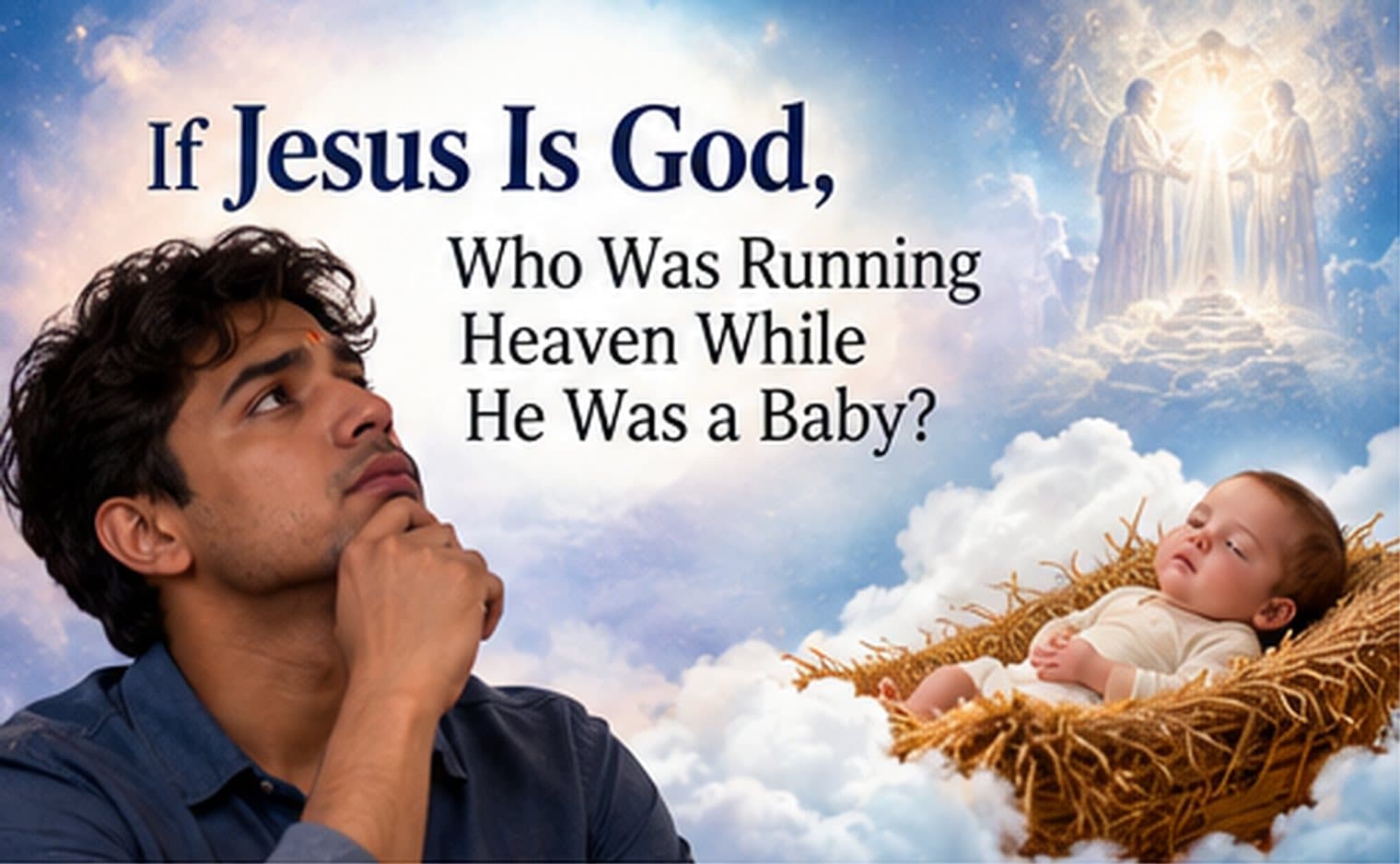
Dinner is almost over. Your dad leans back, half smiling, and asks: "So if Jesus is God, and he was a baby in Bethlehem, who was running the universe? Was heaven just empty for nine months?" Your siblings laugh. You freeze.
It's actually a great question, and Christians have thought about it for 2,000 years. The short answer: God is one God in three persons, the Father, the Son and the Holy Spirit. When the Son became a baby, the Father and the Spirit didn't go anywhere. And the Son himself didn't stop being God. He added a human nature without giving up his divine one. Let's unpack that in plain words.
First: Christians believe in one God, not one person
The question assumes God is a single person who had to leave his post. But the Bible teaches something different, called the Trinity: there is one God, and he exists eternally as three persons.
- The Father is God.
- The Son (Jesus) is God.
- The Holy Spirit is God.
- They are not three gods. They are one God (Deuteronomy 6:4).
- They are not one person wearing three masks. They talk to each other, love each other and send each other.
So when the Son came to earth, heaven wasn't left empty. The Father and the Spirit were still there, and the Son was never separated from them in his divine nature.
Second: Jesus added humanity, he didn't subtract God
This is called the incarnation, which means "becoming flesh." The Son of God didn't stop being God and turn into a man. He stayed fully God and became fully human too. One person, two natures.
That means two things were true at the same time:
- As a human, baby Jesus slept, cried, nursed and had to learn to walk (Luke 2:52).
- As God, the Son kept holding all things together. "He upholds the universe by the word of his power" (Hebrews 1:3).
Christians often put it this way: the Son took on a human nature, but his divine nature was never shrunk down or switched off.
How is this different from an avatar? Your family may say, "So Jesus is like Krishna or Rama, an avatar." In Hinduism, an avatar is a deity's "descent" into a human or animal form to restore dharma, and Krishna says in the Bhagavad Gita (4.7–8) that he comes "age after age." Vishnu is traditionally said to have ten main avatars, and some lists name 24 (Britannica).
The Christian claim is different in a few key ways:
| Avatar (Hindu idea) | Incarnation (Christian belief) | |
|---|---|---|
| How often | Many times, age after age | Once, for all time (Hebrews 9:26) |
| The body | A form the deity appears in | A real, permanent human nature. Jesus is still human today, risen (Luke 24:39) |
| The purpose | Restore dharma, defeat evil | Live the perfect life we couldn't, die for our sins and rise again |
You don't need to attack your family's beliefs to explain this. Just say: "It's similar in one way, God coming down. But Christians believe it happened once, and he stayed human forever."
What the Bible says
These passages are worth knowing by heart for this conversation:
- John 1:1, 14. "In the beginning was the Word, and the Word was with God, and the Word was God... And the Word became flesh and dwelt among us." The Word was with God and was God. Then he became flesh.
- Philippians 2:5–8. Jesus, "though he was in the form of God," "emptied himself, by taking the form of a servant, being born in the likeness of men." Notice how he emptied himself: by taking something on, not by giving up being God.
- Colossians 1:15–17. "By him all things were created... And he is before all things, and in him all things hold together."
- Hebrews 1:3. "He upholds the universe by the word of his power."
- Matthew 3:16–17. At Jesus' baptism, the Son is in the water, the Spirit descends like a dove, and the Father speaks from heaven. All three, at the same moment.
Analogies that help (and where they break)
Every picture of God falls short, and it's honest to say so out loud. Use these to open the door, not to explain everything.
- The author in the story. An author can write herself into her own novel as a character. She's fully in the story, living on its pages, and still fully the author outside it. Where it breaks: a character isn't truly real, but Jesus' humanity is completely real.
- The king who serves. Imagine a king who puts on servant's clothes and works in his own kitchen. He's still the king the whole time. Where it breaks: Jesus didn't just dress up as human. He really became one.
- Your dad at work and at home. The same man is a manager at the office and a father at dinner, at the same time in both roles. Where it breaks: God isn't one person playing three roles. The Father, Son and Spirit are three real persons.
Avoid the common analogy of water as ice, liquid and steam. It suggests God changes from one form to another, which Christians have always rejected.
What to say to your parent
Take the question seriously, even if it was asked as a joke. Curiosity is a good sign. Keep your answer short and invite more questions.
- "That's a really good question. Christians believe God is one God in three persons. When Jesus was a baby, the Father and the Holy Spirit were still in heaven."
- "And Jesus didn't stop being God. He became human too. It's like he added something, he didn't lose anything."
- "I'm still learning this myself. Can I show you the verse that explains it?" (Then share John 1:1, 14.)
- "I honestly don't fully understand it. But I'd expect God to be bigger than I can understand."
It's okay to say "I don't know." Peter tells us to be ready to give a reason for our hope "with gentleness and respect" (1 Peter 3:15). Gentleness matters more than winning.
If you're a hidden believer, a question like this might be a test. Your parent may be trying to find out whether you've become a Christian. You don't have to answer every question on the spot. Something like "That's interesting, I've wondered about that too" is honest and gives you time. Pray, talk with a trusted believer or mentor, and decide when and how you want to share. If sharing openly could put you at risk, your safety matters.
A God who came close
The most amazing part isn't the puzzle. It's the love behind it. The God who holds the universe together chose to be held in his mother's arms. He became one of us so he could rescue us. That's worth sitting with before you ever try to explain it.
Reflect:
- Which verse from this article could you memorize this week?
- Which analogy would make the most sense to your family?
- Who in your family is most curious about Jesus right now?
Sources
Scripture quotations are from the ESV® Bible (The Holy Bible, English Standard Version®), © 2001 by Crossway, a publishing ministry of Good News Publishers. Used by permission. All rights reserved.