
What to do if your parents ask you to wear a bindi
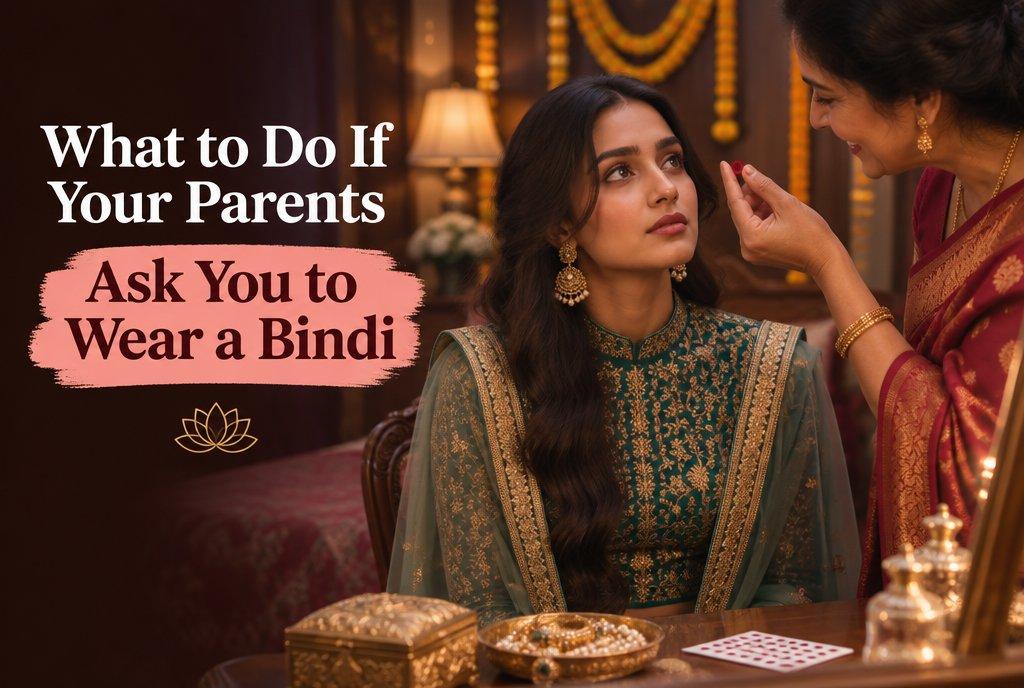
Your cousin's wedding is Saturday. Your mom lays out your lehenga, then hands you a little red dot and says, "Put this on." Your stomach drops. You follow Jesus now, and you're not sure if this is just jewelry or something you shouldn't touch.
If that's you, take a breath. This is one of the most common questions we get from believers in Hindu and South Asian families. The short answer: a bindi is not automatically sin, and it's not automatically harmless. It depends on what it means, where you're wearing it, and what it says to the people watching. Let's walk through the history first, then what Scripture says, then what you can actually do.
Where the bindi comes from (and yes, it has religious roots)
The bindi began as a religious mark, and for many people it still is one. Over time it also became a fashion and marriage symbol. Both things are true at once, which is why this question feels so messy.
The name. "Bindi" comes from the Sanskrit word bindu, meaning a point or a drop. In South India it's called pottu or bottu, and it also goes by teep, tilak, kunkoo and chandlo depending on the region (Utsavpedia).
The spiritual meaning. The spot between the eyebrows is traditionally called the ajna chakra, the sixth chakra or "third eye," believed to be a center of spiritual energy and hidden wisdom. In Hinduism, Buddhism and Jainism the bindi is tied to this idea (Wikipedia). Hindu teaching describes the ajna chakra as the place where a person loses the ego on the way to self-realization (Sanskriti Magazine). Hindu leader Rajan Zed has called it an auspicious religious and spiritual symbol, not a fashion accessory (Academy 4SC).
Protection and luck. The bindi was also believed to ward off the evil eye and bad luck. Some families put a black dot on unmarried girls for this reason (Utsavpedia, Sanskriti Magazine).
Marriage. A red bindi traditionally signals a married woman and stands for love, honor and prosperity. Historically, a widow stopped wearing it (Lacocina).
Worship. In puja and temple settings, the red powder (kumkum) applied to the forehead is often received as a blessing from a deity. Hindu men wear a similar mark, the tilak, as a sign of piety.
Fashion today. Sticker bindis with stones and designs are now common across South Asia, worn with saris, kurtas and even jeans, regardless of religion (Wikipedia). A 2021 Pew survey found 84% of Hindu women in India wear a bindi, but so do 22% of Christian women, 18% of Muslim women and 29% of Sikh women, even though it isn't part of those traditions (Pew Research).
So when your parents hand you a bindi, it could mean "look pretty for the wedding," "show you're a good Hindu girl," or "receive the god's blessing." Those are very different requests.
What the Bible says
The Bible never mentions bindis. But the early church faced almost the exact same problem, and Paul's answer fits our situation surprisingly well.
In Corinth, meat sold in the market had often been offered to idols first. Christians asked: can we eat it? Paul's answer in 1 Corinthians 8 is that an idol is nothing, because there is only one God (8:4–6). The meat itself can't touch you. But he adds two warnings. First, if eating it makes a weaker believer think idol worship is fine, love should hold you back (8:9–13). Second, in 1 Corinthians 10 he draws a hard line: you cannot take part in the actual worship of idols. "You cannot drink the cup of the Lord and the cup of demons too" (10:21).
Then Paul gives a very practical rule: buy meat at the market without asking questions, but if someone tells you "this was offered in sacrifice," don't eat it, for their sake and for conscience (10:25–29).
And Romans 14 adds this: "Whatever does not proceed from faith is sin" (14:23). If you can't wear something with a clear conscience before God, don't wear it.
Applied to the bindi, that gives us a clear principle: the dot itself has no power, but participation in worship is off limits, and what it communicates to others matters.
How to tell the difference
Context decides most cases. A sticker bindi matched to your outfit at a wedding reception is a different act from kumkum pressed on your forehead by a priest at puja.
| Situation | What it usually means | Our take |
|---|---|---|
| Kumkum or tilak applied during puja, aarti or at a temple | Receiving a deity's blessing | Avoid. This is taking part in worship (1 Cor 10:21). |
| Bindi given as part of a religious ceremony or vrat | A sign of devotion or a vow | Avoid. Same reason. |
| Red bindi meant to show you're a "good Hindu" or married woman | Religious and social identity | Use caution. Ask what it signals to the people around you. |
| Decorative sticker bindi with a lehenga at a wedding or party | Fashion, matching an outfit | A matter of conscience. Many Christians are free here. |
| Any bindi you can't wear without guilt | Doubt before God | Don't wear it (Rom 14:23). |
Before you decide, ask yourself honestly:
- Is this an act of worship? If a ritual, prayer or deity is involved, the answer is no.
- What does my family think it means? If they see it as proof you're still Hindu, wearing it may say something you don't believe.
- Can I wear it with a clear conscience? If not, that settles it for you, even if another Christian feels free.
- Would it confuse a newer believer watching me? Love sometimes gives up a freedom.
- Am I doing this out of fear? Honoring parents is good. Hiding Jesus out of fear is a different thing worth praying through.
What to actually do when your parents ask
Honor your parents wherever you can, and hold the line only where worship is involved. "Honor your father and mother" (Ephesians 6:2) still applies to you, even when they don't share your faith. Most of the time you can stay respectful, calm and close to them without compromising.
If it's just for an outfit or a wedding, and your conscience is clear, you may be free to wear it. Some believers choose a small decorative bindi, a different shape or color, or a jeweled one that clearly reads as fashion. You can wear it as an accessory without giving it any spiritual meaning.
If it's tied to puja or a blessing, gently step back. You don't need a sermon. Try:
- "I'll help set up and serve, but I'd rather not do the tilak."
- "Can I just wear the jewelry today? I'm keeping it simple."
- "I love you and I want to be here with you. This part just isn't something I can do."
If you're a hidden believer, wisdom matters. You don't have to announce your faith over a bindi. Jesus told his followers to be "wise as serpents and innocent as doves" (Matthew 10:16). Look for quiet ways to avoid worship without forcing a crisis: arrive after the puja, offer to help in the kitchen, or stand with the cousins in the back. If your safety is at risk, talk with a trusted believer or mentor before taking a public stand.
If you've already worn one in a ritual, you're not disqualified. God knows the pressure you were under. Talk to him about it, receive his grace (1 John 1:9), and decide ahead of time what you'll do next time.
You belong to Jesus, dot or no dot
A bindi can't make you less of a Christian, and skipping one won't make you more of one. What matters is your heart toward God and your love toward your family. Stay out of worship, follow your conscience, and treat your parents with as much honor as you can.
You're not the first believer to stand in a room full of people you love, trying to follow Jesus faithfully. You won't be the last. He sees you in that moment.
Reflect:
- When your family hands you a bindi, what do they think it means?
- Is there a moment coming up (a wedding, Diwali, a puja) you want to plan for now?
- Who is one believer you could talk this through with?
Sources
- Pew Research Center: Religious clothing and personal appearance in India (2021)
- Wikipedia: Bindi (decoration)
- Sanskriti Magazine: Meaning and significance of the bindi
- Utsavpedia: Bindi origin and history
- Academy 4SC: Bindis, the Westernization of a spiritual tradition
- Lacocina: Why do Indians wear bindis?
Scripture quotations are from the ESV® Bible (The Holy Bible, English Standard Version®), © 2001 by Crossway, a publishing ministry of Good News Publishers. Used by permission. All rights reserved.